On-time performance (OTP) is the foundation of rider trust. When a bus arrives when it’s supposed to, riders can build their commutes—and their lives—around it. When it doesn’t, that trust erodes, and so does ridership.
Yet improving OTP is one of the hardest challenges a transit agency faces. Infrastructure upgrades and service expansions can move the needle, but they’re expensive and take years to deliver results. So what can agencies do right now to improve performance with the resources they already have?
Swiftly’s Chief Transit Officer Ritesh Warade recently sat down with Mike Helta, Chief Customer Experience Officer at MDOT MTA, to discuss the agency’s ongoing journey to improve on-time performance.
MDOT MTA has taken a proactive approach based on principles of accurate and accessible data, experimentation, and empowering staff with the best tools possible.
In the conversation below, Mike shares how MDOT MTA is tackling OTP from multiple angles: aligning teams around a common data picture, proactively managing service in real time, equipping operators with better onboard tools, and coaching operators using real-world performance data. Watch a quick preview below, and read on for highlights from the conversation between Ritesh and Mike.
Watch the webinar recording for the full conversation.
Request a meeting with a Swiftly transit data expert to learn more about the technology behind MDOT MTA’s approach.
Building rider trust with more reliable service
Ritesh Warade (Swiftly): So, why the focus on OTP, and why now?
Mike Helta (MDOT MTA): On-time performance is our contract with our rider. This is what they build their lives on. The schedule matters. It’s that first piece of trust that you’re building with the rider: that we will be there when we say we’ll be there. You can depend upon that, and you can bank upon that throughout your day.
One of our core values here at the agency is continuous improvement, so we don’t want to just plateau where we are. We’re at the stage right now where we need to start thinking about some outside-the-box things to try and improve on-time performance.

Ritesh: OTP, in my experience, is not just relevant to operations, or planning, or customer service. It is a massive goal that requires coordination across all the departments at an agency. So how did you start tackling that agency-wide effort?
Mike: We have our Bus Operations Performance Squad, or BOPS. This is a monthly meeting where operations, maintenance, transportation, communication, safety, performance management, planning, service development, and scheduling come to the table. We go through established metrics, discuss where things are, and figure out action steps to improve.
A really important outcome is that there’s a common understanding of the data. Everybody can speak to the data, understand the data, trust the data. From there, we can figure out how to improve.
Experiments to proactively manage service performance
Ritesh: You have run different kinds of experiments to raise the bar with OTP. To start, can you tell us about your project to dynamically manage service to improve OTP?
Mike: Early arrivals are one thing that we as an agency can do something about. Lates, not always. We can’t tell the operator to drive faster, or to operate around safely. But we can tell them to hold up to get back on schedule.
About a year ago, we tested out providing information to our Operation Control Center and having them send out canned text messages to operators who are running early. We saw a 20% reduction in early arrivals at that next time point—just by sending out a text message.
We started to think, how can we be more dynamic with this?
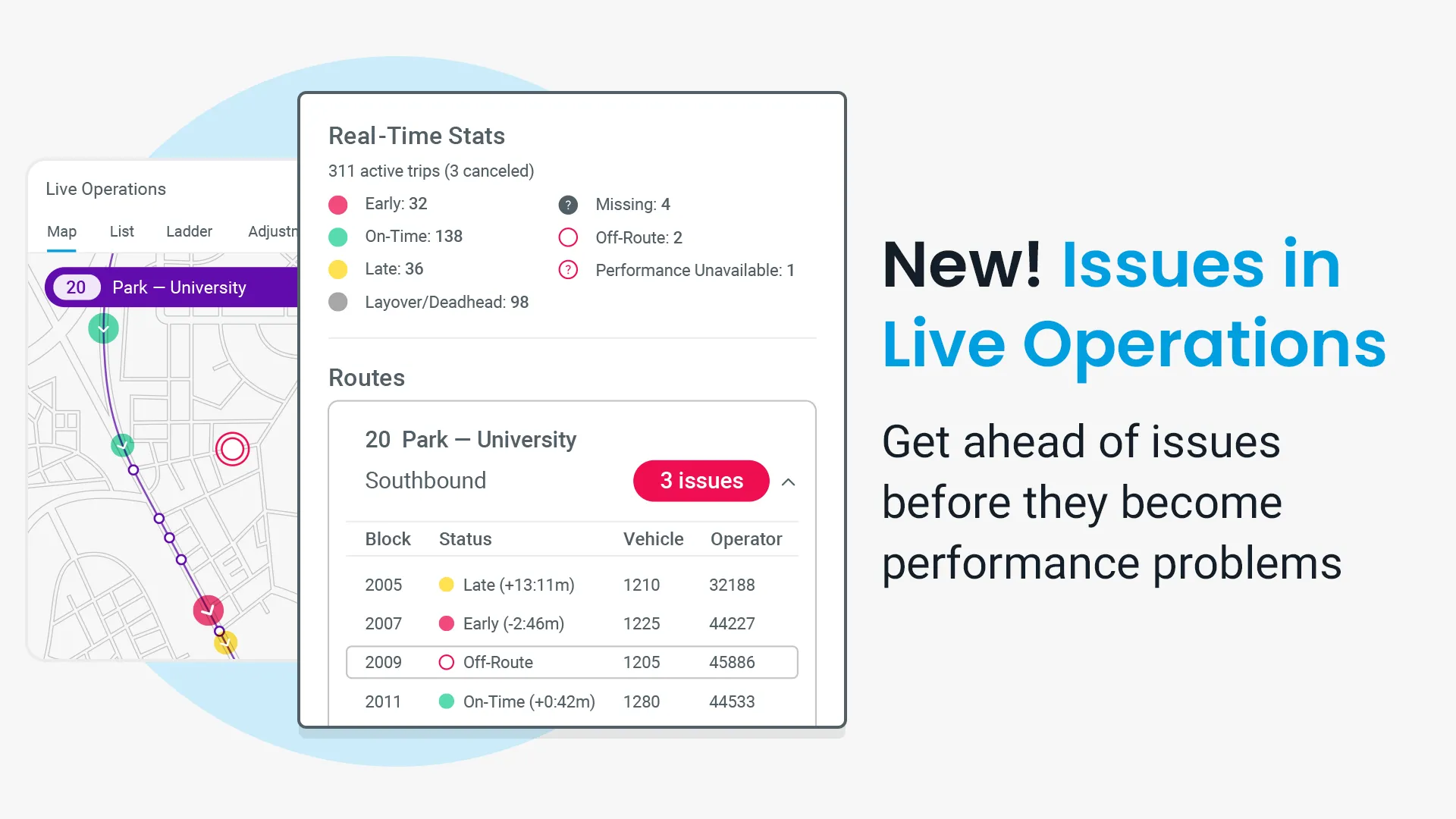
We’re scaling up on that operation with a project that we’re calling Remove the Reds. On Swiftly’s Live Operations map, every early bus is indicated by a red dot. Let’s get rid of those reds.
We’re going to use APIs to take data from Swiftly and develop web tools for our control center that might say, “Here are 6 operators who are running early beyond a certain threshold. Radio them now, because it will be perfect timing for them to hit that time point on-time.” These can be audio announcements in the operator’s cab that they are going to hear.

Investing in the onboard operator experience
Ritesh: How are you thinking about giving operators the tools to manage their OTP on the bus itself?
Mike: One of the answers is to provide them with better tools—easier-to-use and more prescriptive tools.
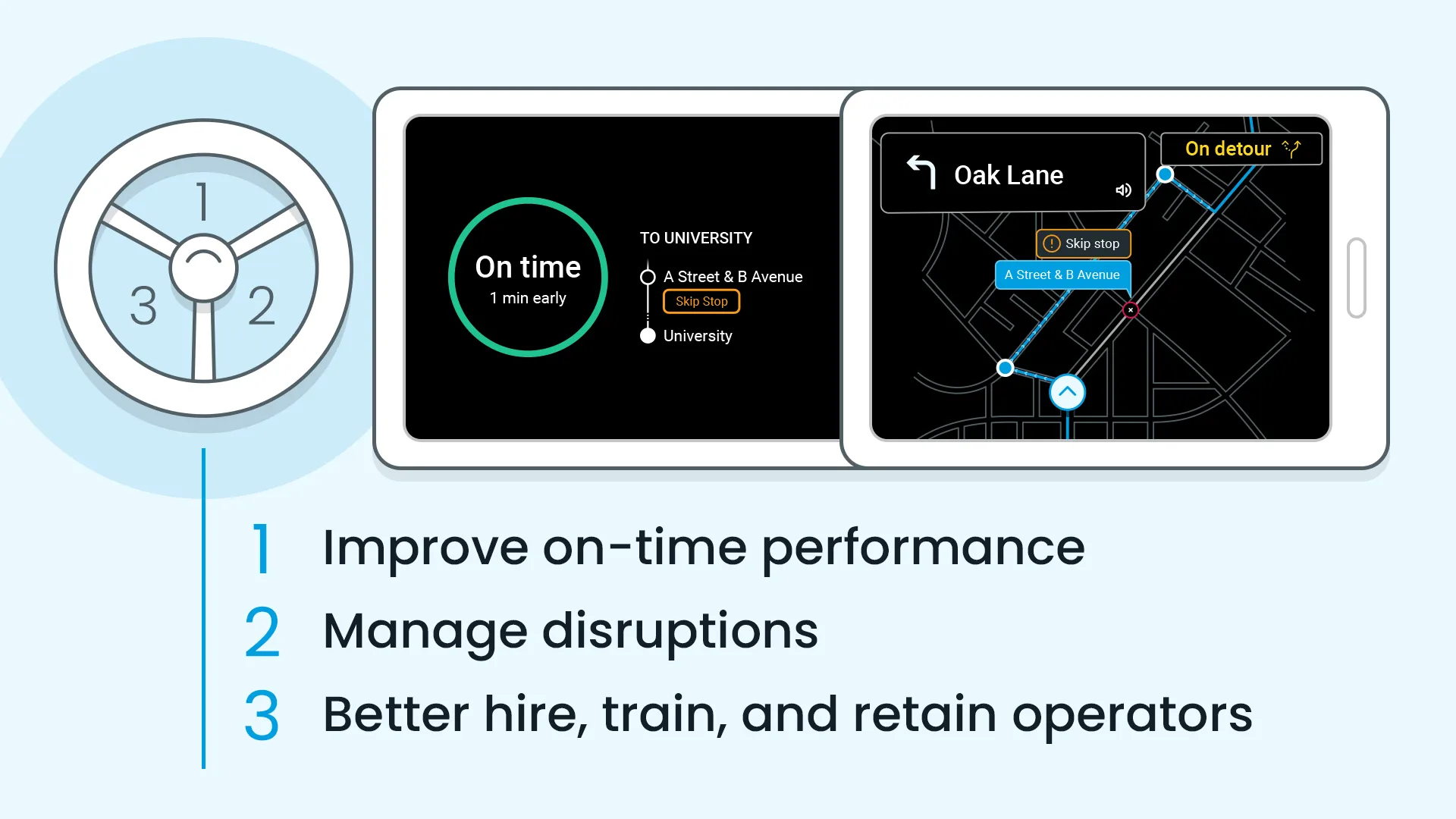
We’re working on deploying Swiftly’s Onboard App. We piloted it last fall for a month on 15 buses. We did the analysis, and buses with Onboard App were 25% more likely to be on time. And early departures were reduced by 37%. We didn’t see a discernible increase in lates, either. Our thinking was, if we put this across the entire fleet, we could see some real serious gains. We’re in that process right now.
We interviewed the operators, and the vast majority said, “This tool’s easy to use. It makes sense. It helps us out.”
Based on the pilot results we saw, this should really move the needle. We’re excited to get good tools in the operators’ hands. I think it’s going to increase the trust our riders have in our service.
Ritesh: That’s really impressive. I talk to a lot of agencies, and I find that even making a 1% improvement to OTP takes a lot of blood, sweat, and tears. How did you get your operators to buy in?
Mike: We did some training, but the tool is super easy to use. We made sure that it wasn’t getting in the way of their view. It provides an additional piece of information to let them know, “Hey, slow down. Hold up.” It gives really easy to understand information.
Learn more about Onboard App
Data-driven operator coaching
Ritesh: So, now you’re proactively managing operations and giving better tools to operators in the field. What about when they’re not driving? How do you change the mindset of operators so that they are thinking about OTP all the time?
Mike: We have so many metrics and so much data that we give to all of our internal staff. It’s data, data, data, dashboard, dashboard, dashboard. Then you look at the operators, and they have no idea what their OTP is. They’re going on gut. They have no feedback unless they’ve done something bad. That’s when they hear from us.
So how are we expecting them to really improve without giving them data?
We’re working on an operator status report that says, “In the past 2 weeks, here’s your on-time performance. In the past month, here’s your on-time performance. Your last pick, how was your on-time performance?” And then we break it down by routes, by direction, and the top 10 early stops.
We’re giving this statistic sheet to the operators, and regardless of whether they’re operating well or poorly, there’s things they can take action on.
We’re going to start looking at the operators who are performing at the lower rung. The bottom 10% of our operators are causing 40–45% of our early arrivals. If we can move that up, we really start to see that on-time performance needle go up.
The idea is that each service change, we pick a small cohort of operators and work with them. We’re going to assign them a coach. We’re going to sit down, look at their stats, and ask, “Where can we improve?”
The coach will build out an action plan, and say, “Northbound on the 54, you’re struggling a lot. Let’s focus on that, and come back in 2 or 3 weeks.” You come back, you get a fresh data sheet, and you say, “Hey, how did we do? Did we see changes here?”
This gives operators tools to manage and develop themselves to be better when they get out there on the street.

We’re looking to pilot with a cohort this summer. We are going to have two or three individuals that are coaches, who are former bus operators. They can speak the language. They understand what it’s like being out there on the Baltimore roads. We’re excited to pair up those two groups. I don’t think anybody likes to operate poorly, so let’s give them information that helps them improve.
Ritesh: Every operator I’ve ever met takes a lot of pride in their work. I sometimes joke that operators are probably using Google Maps or Waze to drive to the garage. Then they get a clunky piece of technology or a piece of paper with left and right turns, and we tell them, “Here, drive a 60-foot bus.” The tools are actively working against them.
Mike: Kudos to our operators. They deal with a lot. We owe it to them to provide them with information that allows them to operate with more awareness and confidence.
This is a step in the direction of giving them the tools that we often have internally. The information we get on our computers is pretty good. Why don’t operators have that information? So let’s change that.