NTD data helps decide how over $5 billion in federal transit funding is apportioned to urbanized areas every year. The stakes are high for transit agencies of all sizes.
Every trip your agency runs generates the data behind your NTD report. The report is only as reliable as that data.
For some transit agencies, NTD reporting still means pulling service data from a CAD/AVL system, ridership data from somewhere else, and bringing it all together in a spreadsheet.
Even agencies receiving NTD-related reports directly from their CAD/AVL system need to worry about data reliability. When missed trips, partial trips, midday vehicle swaps, or interlined blocks aren’t handled correctly in the underlying data, agency staff manually correct the discrepancies before every submission. The result is long hours spent copying data across spreadsheets, merging sources, and redoing calculations.
Different agencies with different workflows face the same problem: The raw data already exists. But getting information that is reliable enough to submit with confidence still takes too much work.
The Federal Transit Administration estimates an annual burden of more than 456,000 hours on NTD respondents and says it continues to look for ways to reduce that burden.
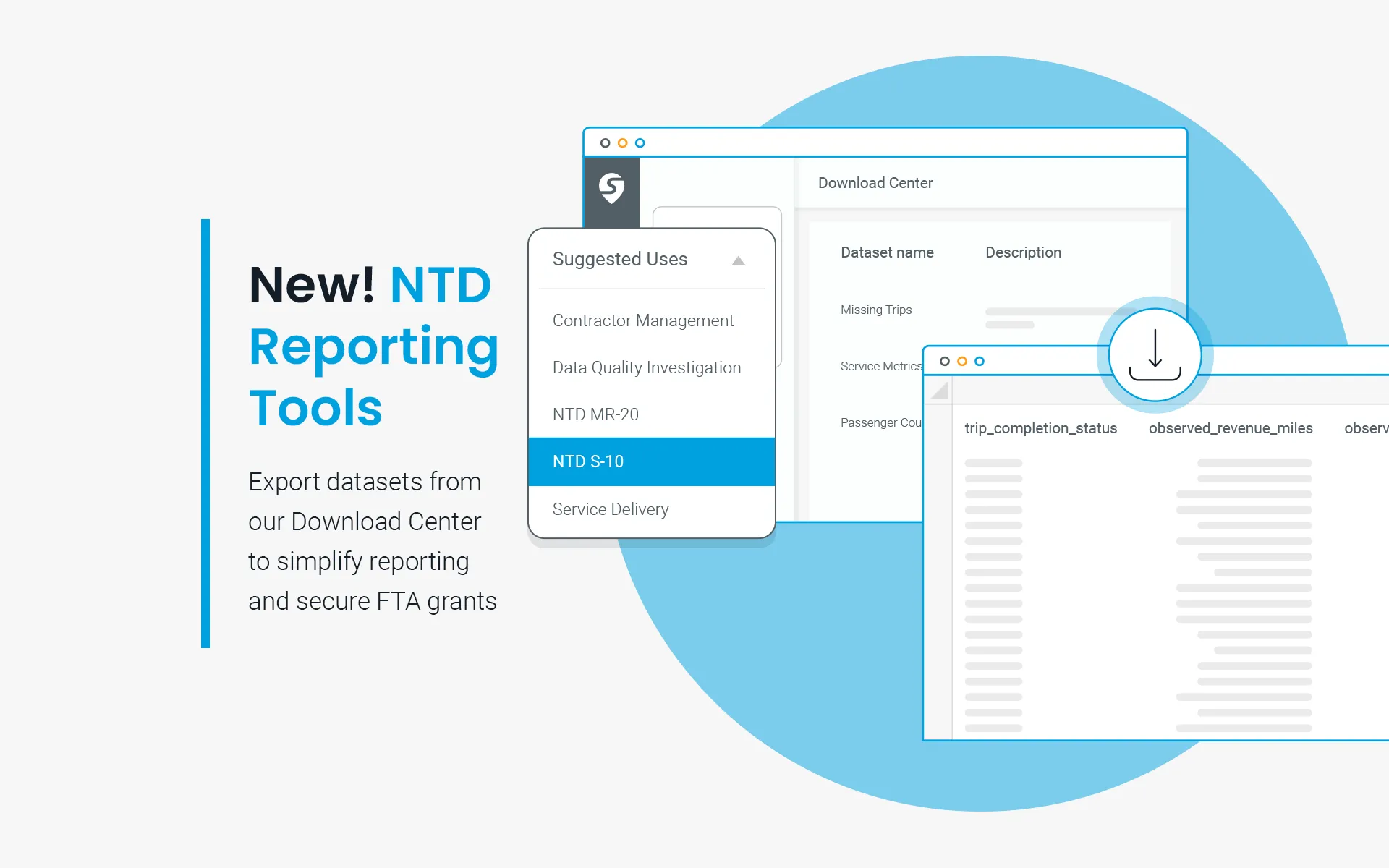
Enter Swiftly's NTD Download Center, built on the same operations and ridership data agencies use to run service every day.
Review, don’t rebuild: How the NTD Download Center works
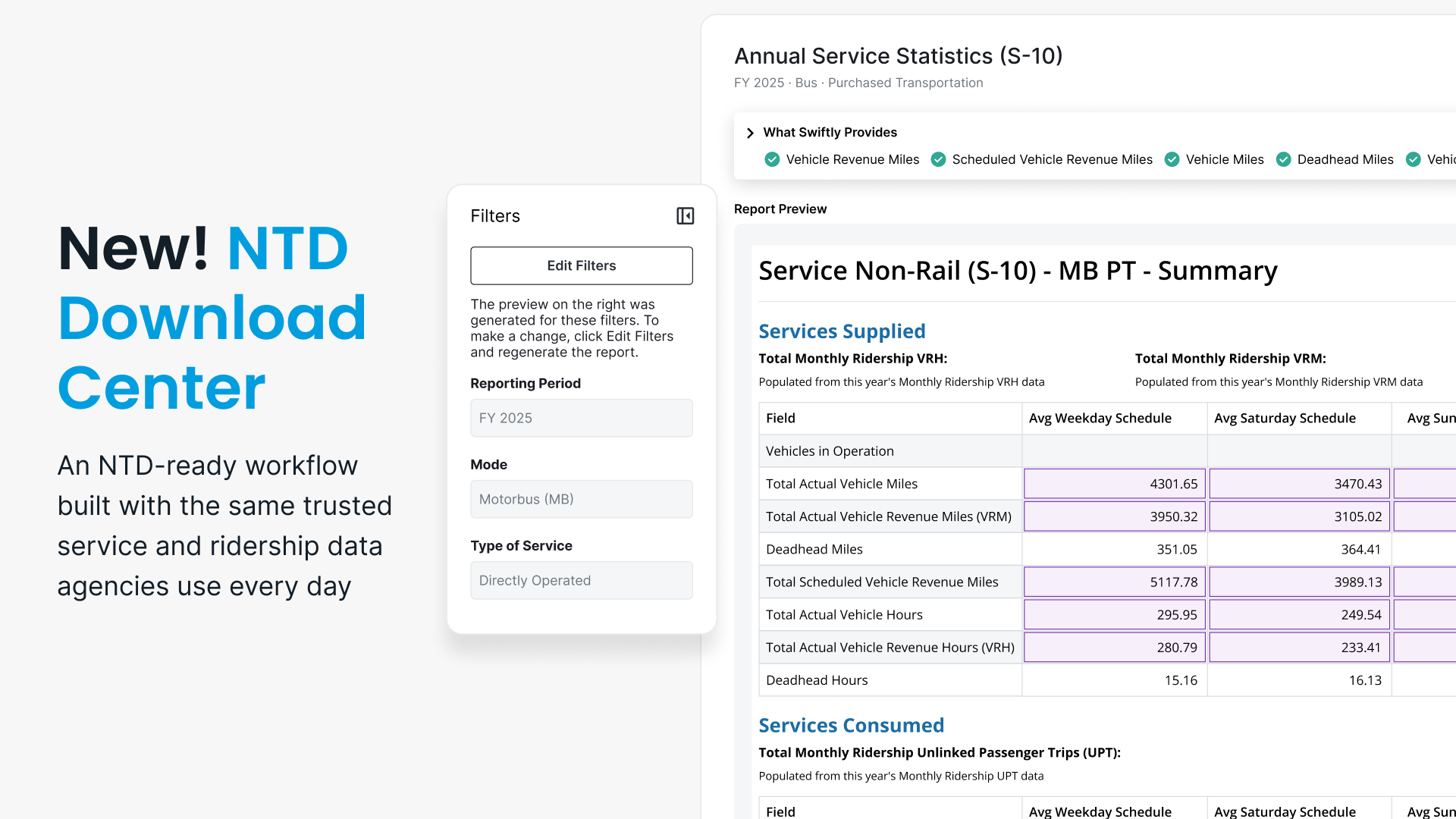
With the Swiftly NTD Download Center, the numbers in your report come from the same Swiftly data sets your team already relies on for on-time performance, ridership and day-to-day operations. When you check a number, you’re checking it against data you already know and trust.
Agencies can generate pre-formatted data for three commonly used NTD reports:
- S-10 for annual service reporting by Full Reporters
- MR-20 for monthly reporting by Full Reporters
- RR-20 for annual reporting by Reduced Reporters
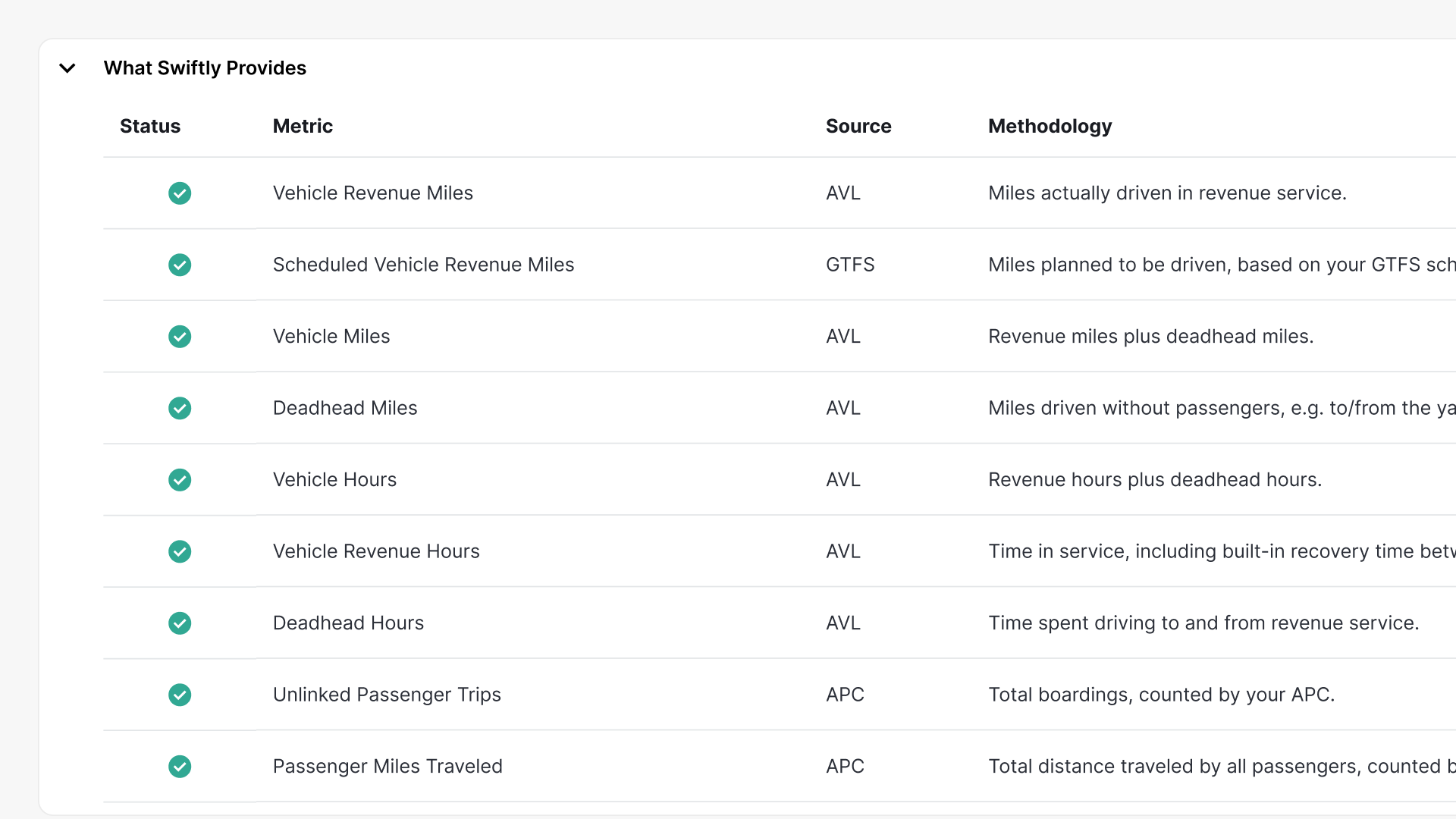
Depending on the report and the data available in Swiftly, this includes metrics such as Vehicle Revenue Miles (VRM) and Unlinked Passenger Trips (UPT). The full list is below.
Configure your agency-specific reporting settings once, and each cycle is as simple as selecting the reporting period, reviewing the Swiftly-provided metrics, and exporting. Review, don’t rebuild.
For lean teams, repeatability matters even more
At a smaller agency, the staff member preparing an annual RR-20 may also be managing schedules, grants, operations, or other priorities.
A once-a-year workflow shouldn’t have to be reinvented every year.
For Reduced Reporters, NTD Download Center brings Swiftly-supported annual VRM and UPT metrics into a pre-formatted RR-20 workflow.
Configure the agency-specific settings once, and the same setup can support the next reporting cycle. And when reporting responsibility changes hands, the process stays with the agency, not the person who built the spreadsheet.
How the NTD Download Center fits with your CAD/AVL system
The new NTD Download Center ensures more accurate, more efficient NTD reporting, either as part of Swiftly CAD/AVL or alongside your existing CAD/AVL system.
Already running Swiftly’s CAD/AVL? For the 60+ agencies on Swiftly CAD/AVL, NTD reporting has meant pulling data out of Swiftly and building the report somewhere else. NTD Download Center gives you the numbers already formatted for each NTD form, ready to review and copy straight into your submission.
Reporting from another CAD/AVL? If your current system produces an NTD report that still needs reconciling, recalculating, or checking before you submit, the gap isn’t the report. It’s whether you can trust what’s in it. With Swiftly, the data that runs service every day is the same data behind your NTD report, so every number can be checked against it.
Either way, NTD Download Center starts with the data you already have in Swiftly, whether that’s service data, ridership data, or both. If your ridership data comes from Automatic Passenger Counters (APCs) processed through Swiftly Ridership, your agency will need to certify that data for NTD reporting. Our guide to NTD certification walks through that step.
Evaluating a new CAD/AVL? NTD reporting continuity is one of the biggest risks in any CAD/AVL switch. The question isn’t just “Does the new system support NTD reporting?” It’s “What will our reporting workflow look like after we switch, and will we trust the numbers?” With Swiftly, you can answer that before the switch. NTD Download Center runs entirely as software, so your agency can start using it without touching a single vehicle.
From running service to reporting on it
On Swiftly's Transit Data Platform, the data that staff rely on to run service every day is the same data behind your NTD reporting. With one source, calculations stay consistent, there are fewer manual steps, and every number can be checked against data your team already uses.
Review, don’t rebuild. Want to simplify your agency’s path to NTD-ready reporting? Talk to our team.