Higher education communities have unique needs for transit. Population density, scarce and expensive parking, and low rates of car ownership all lead students to rely on transit to get to class.
Just as significantly, students tend to be tech-savvy and turn to consumer trip-planning apps for information. Before heading to class, a student might pull up Google Maps or Transit to check bus departure times, compare travel time with a bike-share or scooter share, and pay for their fare.
And when real-time passenger information is unavailable or, potentially worse, inaccurate, students are not shy about speaking up.
Yet the full-service technology solutions that cater to the broader transit industry are not always accessible for campus transit systems. So how can campus transit providers ensure reliable service for students within their budgets and operational resources?
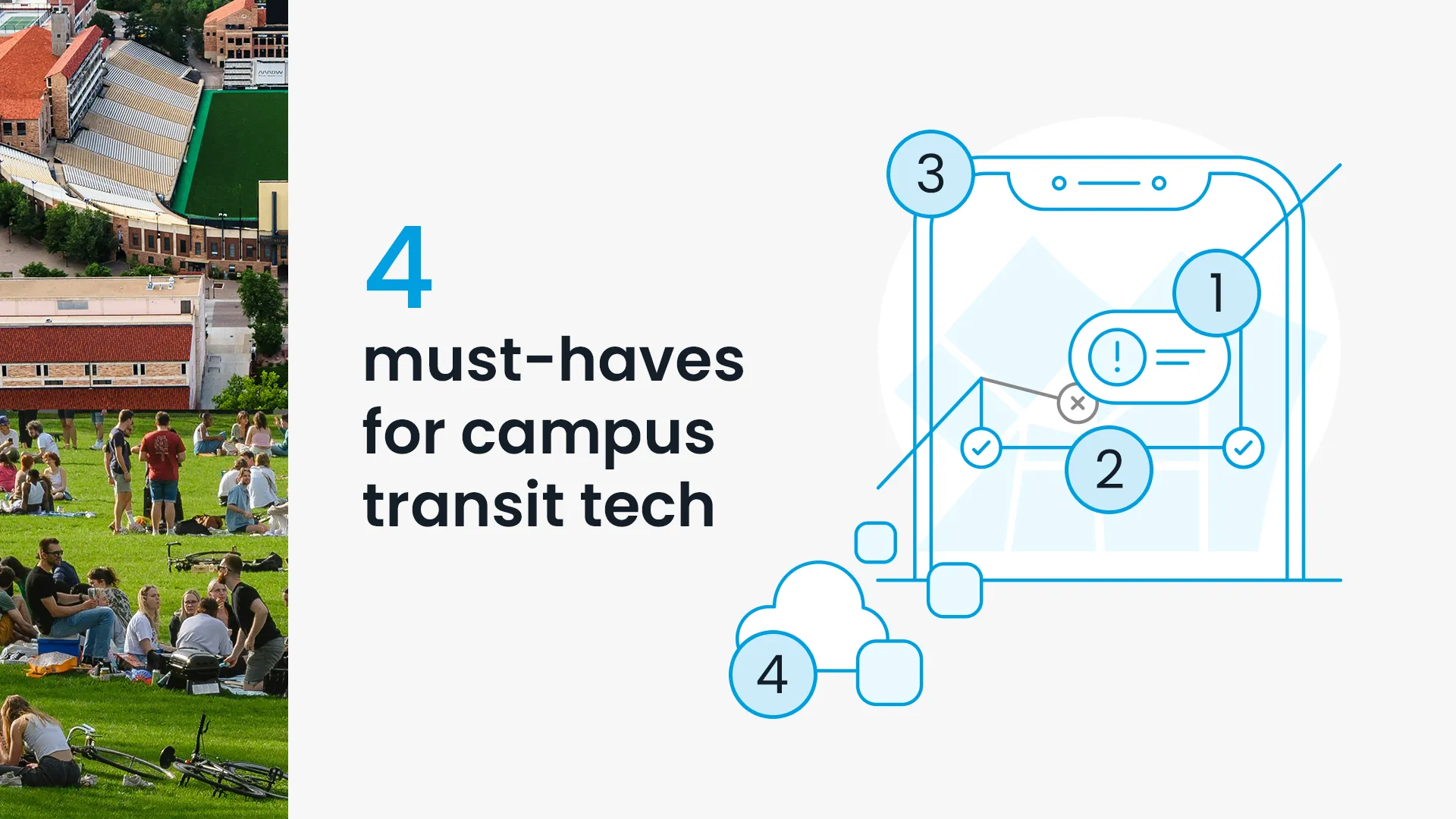
The answer lies in investing in reliable, accessible transit data. Read on for four requirements for universities to make the most out of transit technology by investing in better data.
”At UMBC, ensuring that our transportation system is safe, reliable, and responsive is paramount. The integration of real-time vehicle tracking and passenger information through our partnership with Swiftly has been a game-changer in achieving these goals.”
Daniel Teage, Associate Director of University of Maryland, Baltimore County (UMBC) Transit.
Teage continues, “Accurate real-time data empowers our students, faculty, staff, and researchers with the confidence to make informed travel decisions, reducing wait times and enhancing overall satisfaction. This commitment to leveraging cutting-edge technology improves operational efficiency and reinforces our dedication to delivering a superior transit experience for our campus community.”
1. Accurate, accessible real-time passenger information
Nothing frustrates a student transit rider more than checking the bus time on a trip-planning app, showing up at the bus stop just in time to catch the bus to your midterm, but seeing the bus a few blocks down the street already because it departed two minutes early.
Transit app’s annual Rider Happiness Benchmarking survey regularly finds accurate real-time information as the number one factor in increasing transit ridership. Not only have Swiftly’s predictions been proven to be 50% more accurate than other providers, but we also worked with Transit to support the industry’s first benchmark for prediction accuracy, so universities can compare their prediction accuracy with peer agencies.
Even accurate arrival predictions are only helpful when they’re also accessible. Making real-time passenger information available in the GTFS-rt format ensures students can turn to the trip-planning app of their choice for accurate arrival predictions.
Swiftly’s new partnership with ActionFigure ensures that universities can feed real-time transit info straight into their existing campus apps without building anything custom—no public GTFS feed required—and also display upcoming arrivals at transit centers.
Read on to learn more in Section 3 about the importance of a consumer-grade mobile app experience.
2. Building trust through disruptions
Prediction accuracy is only one component of real-time passenger information.
What about those days when a student shows up to their daily stop to wait for a bus that never comes? Universities are no strangers to events that cause changes to service—campus events, winter storms, winter and summer breaks.
Universities are engaging student riders today with proactive rider alerts that notify the community of changes to service and disruptions, or even just welcome students back for the first week of a new semester.
The results are better informed, more connected transit riders. For example, the University of Colorado in Boulder (CU Boulder) reduced monthly complaints of “ghost buses” by 75% after they started proactively communicating service changes to passengers.
Request a demo
3. Consumer-grade mobile app experience
As a relatively tech-savvy population, students have no patience for a clunky mobile app experience.
Real-time passenger information solutions based around a customized mobile app—to the exclusion of common consumer apps like Google Maps and Transit—are destined to result in endless complaints.
Fortunately, any school can provide a best-in-class mobile experience to riders by making data available in a GTFS-rt format to consumer trip-planning apps like Transit and Google Maps.
Teage at UMBC reinforced the importance of providing information through a consumer mobile app: “A high-quality mobile app experience is crucial in delivering real-time information seamlessly, allowing users to access bus locations, schedules, and service alerts at their fingertips.”
Transit even offers several features specifically for university populations through its Royale for Agencies partnership model, including integration of limited-access systems like UMD’s Shuttle-UM, such that only students and staff see trip-planning and departure info for their campus’ routes while also having access to local transit systems; gamification that awards riders points each time they choose to use public transit; and custom co-branding such that students associate the app to their school.
4. Deployment built for campus scale
Most CAD/AVL systems were built for a different era, one that assumed large IT teams, dedicated server infrastructure, and multi-year implementation budgets. Campus transit teams rarely have any of these, and shouldn’t need them to provide reliable service and accurate passenger information. Swiftly deploys in weeks, runs without on-site hardware, and updates automatically so universities can focus on serving riders instead of managing technology. It’s the operational foundation campus transit teams need without the implementation burden they can’t afford.
Get started with transit data therapy
With these four technology traits, any university or college can provide students with a premium rider experience. Swiftly offers complimentary consultations, or “data therapy” sessions, to help you get started evaluating your own transit data.
Schedule a consultation with one of our experts today, and we’ll work with you on a roadmap to providing students with accurate, reliable real-time passenger information.